The § 7520 Rate and Charitable Remainder Unitrusts: What It Determines, What It Doesn't
Looking for the current § 7520 rate?
The IRS § 7520 rate changes every month. The current rate, the two preceding months (relevant to the donor’s three-month election under Treas. Reg. § 1.7520-2(a)(2)), and a historical record are maintained on the live tracker.
Jurisdiction: Federal (I.R.C. §§ 664, 7520); California conformity
Primary Statutes: I.R.C. §§ 664, 7520; Treas. Reg. §§ 1.664-3, 1.664-4, 1.7520-2; Rev. Proc. 2005-52
IRS Publications: Publication 1457 (annuity factors); Publication 1458 (unitrust factors)
Last Reviewed: April 2026
Category: Charitable Planning | Income Tax | Trusts
Executive Summary
The IRS § 7520 rate has one function in Charitable Remainder Trust planning: it influences the actuarial calculation that produces the donor’s charitable deduction at the moment the trust is funded. That is its only role. The § 7520 rate does not predict trust returns, govern annual distributions, or determine the value ultimately received by the charity. Those outcomes are products of asset allocation, market performance, payout rate selection, and trustee judgment — variables the IRS discount rate does not touch.
This article addresses the Charitable Remainder Unitrust (CRUT) specifically. The CRUT is the dominant form of CRT in current practice — the substantial majority of new and existing trusts (see Gottlieb, Charitable Remainder Trusts: A Decade After the Last IRS Study, Tax Notes Federal, Mar. 9, 2026). The § 7520 rate operates differently in Charitable Remainder Annuity Trust (CRAT) planning, with materially greater sensitivity to rate movements; that distinction is outside the scope of this article.
For CRUTs, two things deserve unusual emphasis. First, the § 7520 rate’s effect on the deduction is real but modest — much smaller than the conventional explanation implies. The dominant variables in a CRUT remainder calculation are the payout rate, the term, and (for life-contingent trusts) the beneficiary’s age. The § 7520 rate enters as a payment-timing adjustment, not as the primary driver. Second, even when the deduction calculation is fully optimized, what happens after funding — investment performance, trustee discipline, distribution rate selection — matters far more than the § 7520 rate at inception. The fixation on the monthly rate distorts planning conversations and crowds out the variables that actually determine outcomes.
Governing Law
The Split-Interest Structure: I.R.C. § 664
A CRUT is a split-interest trust under I.R.C. § 664 that pays a fixed percentage of the trust’s annually revalued fair market value to one or more non-charitable beneficiaries for a term of years (up to 20) or for life, with the remainder passing to a qualified charitable organization. The trust itself is exempt from income tax during its term — one of the most significant economic features of the vehicle.
The unitrust payout structure has two practical consequences that distinguish it sharply from the CRAT alternative. First, distributions rise and fall with the portfolio: the income beneficiary participates in both upside and downside. Second, additional contributions to the trust are permitted (Treas. Reg. § 1.664-3(b)) — a CRUT can grow over time through subsequent gifts, where a CRAT cannot.
The § 7520 Rate and the CRUT Deduction: I.R.C. § 7520
I.R.C. § 7520 requires the IRS to publish a monthly discount rate equal to 120% of the applicable federal midterm rate, rounded to the nearest two-tenths of one percent. For a CRUT, that rate enters the deduction calculation through the adjusted payout rate — a Treas. Reg. § 1.664-4 / IRS Pub. 1458 Table F adjustment to the stated payout that accounts for payment timing (frequency and the gap between valuation and payment dates).
The mechanics: a higher § 7520 rate produces a marginally lower adjusted payout rate, which produces a slightly larger remainder factor and therefore a slightly larger deduction. Directionally, higher rate equals larger deduction. But the magnitude of this effect for a CRUT is small.
For a detailed treatment of the underlying actuarial mechanics — including derivation from first principles and a critique of common misstatements about how the rate functions — see Gottlieb, Klaus, Opening the Black Box: The Actuarial Derivation of the CRUT Charitable Deduction (May 17, 2026), available at https://ssrn.com/abstract=5924942.
Strategic Rate Selection: The Three-Month Election
Treas. Reg. § 1.7520-2(a)(2) allows a donor to elect the § 7520 rate for the month of funding or for either of the two immediately preceding months. The donor may select whichever of the three available rates produces the most favorable deduction. In practice, this means running the calculation under all three rates before funding and selecting the highest-deduction outcome.
Whether the optimal election is the current month or one of the two preceding months depends on rate direction. In a rising-rate environment, the current month is typically optimal; in a falling-rate environment, one of the preceding months may be. The election is made on the donor’s tax return for the year of funding and should be documented contemporaneously. Because the magnitude of the rate’s effect on a CRUT deduction is small, the dollar gain from the optimal election is correspondingly modest — but it is essentially free, and there is no reason to leave it on the table.
🔧 RUN ALL THREE RATES
The CRUT Deduction Calculator at CalCRUT.com applies IRS-prescribed methodology and the 2010CM mortality tables to compute the deduction under any combination of payout rate, term, and § 7520 rate. The companion § 7520 Rate Tracker displays the current month’s rate alongside the two preceding months — the three rates from which the donor must elect. Together, they convert the three-month election from a regulatory entitlement into a routine pre-funding step.
Carryforward: The Five-Year Deduction Period
The charitable deduction for a CRUT contribution is subject to the standard percentage-of-AGI limitations applicable to contributions to public charities — generally 30% of AGI for appreciated capital gain property contributed to a public charity remainder beneficiary, and 50% for ordinary income property. Amounts that cannot be deducted in the year of funding may be carried forward and deducted over up to five succeeding tax years. Donors with unusually large contributions relative to current income can therefore still capture the full deduction over time, though carryforward modeling should be done at funding rather than discovered later when the deduction is partially stranded.
What the § 7520 Rate Does and Does Not Determine
⚠️ CRITICAL MISCONCEPTION: The § 7520 rate is a deduction-sizing mechanism at inception. It is not a measure of CRUT performance, a predictor of trust returns, or a reason — by itself — to establish or avoid a CRUT. Conflating the deduction calculation with the economics of the trust is one of the most common errors in CRUT planning conversations.
| Question | Does § 7520 Rate Control This? | What Actually Controls It |
|---|---|---|
| Size of the initial charitable deduction | Partially — modest effect | Primarily the payout rate, term, and beneficiary’s age; § 7520 rate adjusts for payment timing |
| Annual income distributions to beneficiary | No | Trust assets × payout rate, revalued annually |
| Portfolio growth and total return | No | Asset allocation, market performance, investment manager |
| Value ultimately received by charity | No | Trust performance over the full term, net of distributions |
| Whether a CRUT outperforms a direct sale | No | Tax drag, investment returns, holding period, individual facts |
The right question at the planning stage is not “is the § 7520 rate high enough to fund a CRUT?” The right questions are: Does this donor hold appreciated, low-basis assets generating little current income? Is there genuine charitable intent? What is a defensible expectation for investment performance over the trust’s term? Does the CRUT structure — compared with a direct sale, hold-to-death, or other alternative — produce a better outcome across the realistic range of scenarios?
Those are economic and actuarial questions. The § 7520 rate answers none of them.
CRUT Deduction Sensitivity to the § 7520 Rate
The conventional explanation of the § 7520 rate’s role frames it as a major driver of the charitable deduction. For a CRUT, that framing overstates the rate’s influence. The dominant inputs to the CRUT remainder factor are the payout rate, the term (or beneficiary’s age), and — through the adjusted payout rate — the payment frequency. The § 7520 rate enters only through the payment-timing adjustment, which in turn moves the remainder factor by a small amount.
The figure below illustrates the actual sensitivity using a clean, single-variable comparison: the same CRUT (a $1 million corpus, 5% payout, 20-year term, quarterly distributions) calculated at three different § 7520 rates.
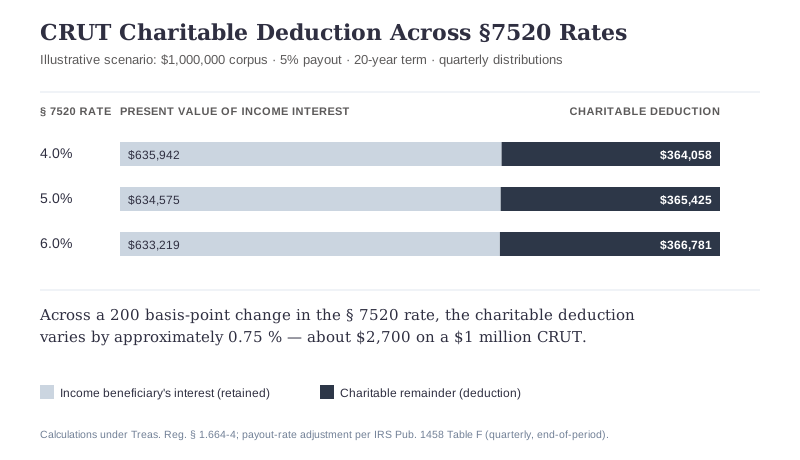
Across a full 200 basis-point swing in the § 7520 rate — a move larger than what occurs in most planning windows — the charitable deduction varies by approximately three-quarters of one percent. The income beneficiary’s interest and the charitable remainder shift by roughly $1,400 in either direction. For a $1 million CRUT, the choice between the three available rate elections is rarely the largest dollar variable in the planning conversation.
This is not an argument against optimizing the three-month election — the optimization is essentially free, and the dollars are real. It is an argument against treating the monthly § 7520 rate as the central variable in a CRUT decision. The variables that genuinely move the deduction calculation are upstream: the payout rate the donor selects, the term or life expectancy the trust runs for, and (for split-life or two-life trusts) the beneficiaries’ ages. The variables that move the trust’s economic outcome over its full life are different again: investment policy, distribution discipline, and trustee governance.
CRUTs as a Planning Vehicle: When Suitability Is Present
A CRUT merits serious consideration when several conditions are present together. The vehicle is not universally appropriate, and it does not become more appropriate simply because the § 7520 rate happens to be high in a given month.
Appreciated, Low-Basis Assets
The CRUT’s core tax advantage is that the trust — as a tax-exempt entity under § 664 — can sell appreciated assets inside the trust without triggering immediate capital gains tax. The full proceeds reinvest, and capital gains are recognized by the income beneficiary only as distributions are received under the trust’s four-tier income ordering rules. The deferral and potential conversion of character can be substantial for donors with highly appreciated stock, real estate, or business interests — particularly in scenarios where a near-term liquidity event would otherwise trigger a single-year capital gains spike at the highest marginal rates.
Charitable Inclination
The charitable remainder is irrevocable. A donor with no charitable inclination whatsoever — who genuinely has no interest in benefiting any charitable organization — should look at other planning vehicles. The CRUT is not the right tool for purely tax-driven transactions with no philanthropic dimension.
That said, many donors who initially resist the idea of a charitable remainder change their view once they understand the full picture. The combination of capital gains deferral, a meaningful income stream, a current tax deduction, and a legacy contribution to a cause that matters to them often looks quite different from the blunt premise of “giving your money away.” Advisors who frame the charitable remainder as a loss rather than a planned gift frequently never get past that framing to the actual planning conversation. Donors with even a modest charitable inclination — a university they attended, a hospital that treated a family member, a community foundation in their area — are often well-served by a CRUT once they see how the economics work across their specific facts.
Timing: High-Income Years
The deduction is most valuable in years of unusually high income — a business sale, large bonus, equity vesting event, or other income spike — where the donor faces a high marginal rate. Funding a CRUT in such a year can shelter a meaningful portion of that income. For donors anticipating retirement and a permanent drop in income, a CRUT established in the final high-earning years can produce both a current deduction at the highest marginal rate and a lifetime income stream taxed (in many cases) at lower rates as it is received in retirement.
Economic Performance: Investment-Driven, Not Rate-Driven
Once a CRUT is funded, performance is governed entirely by the portfolio inside the trust. The § 7520 rate that determined the original deduction is irrelevant to what happens next.
For a CRUT paying, say, 5% of annually revalued assets, the trust must generate total returns above 5% to avoid erosion of principal — and therefore to avoid declining distributions over time. Whether that is achievable depends on asset allocation, market conditions, and investment management. A CRUT funded in a period of strong equity returns will produce dramatically different outcomes from one funded with a conservative fixed-income allocation, regardless of the § 7520 rate at inception.
This is not a theoretical concern. Monte Carlo analysis across historically calibrated market scenarios demonstrates that outcomes for income beneficiaries and remainder charities vary by an order of magnitude based on investment assumptions — and only marginally based on reasonable changes in the § 7520 rate. The Payout Path Monte Carlo simulator at CalCRUT.com lets advisors and donors visualize the distribution of outcomes across thousands of return paths, so the choice of payout rate and asset allocation can be evaluated against a realistic range of futures rather than a single point estimate.
The trustee’s investment decisions therefore matter enormously — arguably more than any other single variable in CRUT planning. A donor who funds a CRUT and then permits the trustee to pursue a strategy misaligned with the distribution rate, time horizon, and charitable goals has made a structurally sound decision that may still produce poor results.
📌 PLANNING NOTE. The § 7520 rate should be checked and the three-month election evaluated at funding. After that, the advisor’s attention should shift entirely to investment policy, payout rate selection, and trustee governance. These are where performance is made or lost.
Practice Notes
At Funding
- Run the deduction calculation under all three available § 7520 rates (current month and two preceding months) using the CRUT Deduction Calculator and select the most favorable
- Confirm the applicable AGI limitation (30% for capital gain property to public charity remainder; 50% for ordinary income property) and model the five-year carryforward
- Verify that the 10% minimum remainder requirement under I.R.C. § 664(d) is satisfied at the selected payout rate, term, and § 7520 rate — this is a legal prerequisite, not a planning preference
- Confirm the payout rate is between 5% and 50% as required by § 664(d)(2)(A)
- Document the donor’s charitable intent and acknowledged understanding that the remainder is irrevocable
Trustee and Investment Policy
- Establish a written Investment Policy Statement (IPS) that reflects the payout rate, distribution horizon, and charitable goals
- Confirm the trustee understands the relationship between total return, the payout rate, and the long-term effect on distributions and the charitable remainder
- A payout rate set above expected long-term returns will predictably erode assets over time — a foreseeable outcome that should be disclosed at funding, not discovered years later when the corpus is already meaningfully diminished
Ongoing Administration
- The CRUT requires annual revaluation of trust assets to compute the unitrust distribution
- The trustee files Form 5227 (Split-Interest Trust Information Return) annually
- Distributed income retains its character under the four-tier ordering rules: ordinary income first, then capital gains, then other income, then corpus
⚠️ COMMON ERROR: Advisors and clients sometimes interpret a declining § 7520 rate as a reason to delay funding a CRUT, on the theory that the deduction will be smaller. This inverts the analysis. If the underlying planning rationale is sound — appreciated assets, genuine charitable intent, appropriate income need — the § 7520 rate’s effect on the deduction is one factor among many, and for a CRUT a rather small one. A modestly smaller deduction in a lower-rate environment does not eliminate the capital gains deferral benefit, the income stream, or the charitable legacy. Delaying funding based on the § 7520 rate alone sacrifices those benefits in pursuit of a marginal upfront deduction.
Frequently Asked Questions
What is the current § 7520 rate?
The IRS publishes the § 7520 rate monthly in a revenue ruling, typically released around the 18th of the preceding month. The current month’s rate, the two preceding months (relevant to the three-month election available to charitable donors), and a historical record are maintained on the § 7520 rate tracker at CalCRUT.com. Static reference articles cannot reliably display monthly rate data; the live tracker is the authoritative source for current values.
How much does the § 7520 rate actually affect the CRUT deduction?
For a CRUT, less than the conventional explanation suggests. In a representative scenario — $1 million corpus, 5% payout, 20-year term, quarterly distributions — the deduction varies by less than 1% across a 200 basis-point change in the § 7520 rate (see the figure above). The dominant variables in a CRUT remainder calculation are the payout rate, the term, and (for life-contingent trusts) the beneficiary’s age. The § 7520 rate enters as a payment-timing adjustment, not as the primary driver. This is one of the structural differences between CRUTs and CRATs that explains why CRUT planning is more stable across rate environments.
What is the § 7520 rate used for?
The § 7520 rate is the IRS-prescribed discount rate used to compute the present value of certain interests in trusts — specifically annuities, life estates, and remainder interests. For Charitable Remainder Unitrusts, it enters the deduction calculation through the adjusted payout rate (Treas. Reg. § 1.664-4; IRS Pub. 1458 Table F). The rate is also used in valuing Grantor Retained Annuity Trusts (GRATs), Qualified Personal Residence Trusts (QPRTs), Charitable Lead Trusts (CLTs), private annuities, and other split-interest arrangements.
What is the § 7520 rate for life estates?
There is no separate § 7520 rate for life estates. The same monthly § 7520 rate is used to value life estates, remainders, term-of-years interests, and annuities. The valuation calculation differs depending on whether the interest is life-contingent (in which case mortality tables — currently 2010CM — are applied) or term-certain (in which case only the discount rate and term are needed). The rate is the same across all these uses; the actuarial methodology differs based on interest type.
How does the § 7520 rate differ from the AFR?
The Applicable Federal Rate (AFR) is published monthly by the IRS in the same revenue ruling that announces the § 7520 rate. AFRs are published in three tiers — short-term, mid-term, and long-term — for use in computing imputed interest, original issue discount, and certain other tax calculations. The § 7520 rate is derived from the AFR: it is 120% of the annual mid-term AFR, rounded to the nearest two-tenths of one percent. The AFR and § 7520 rate are released together each month, but they serve different functions and are not interchangeable.
How do I know which AFR rate to use?
For non-charitable transfers, the § 7520 rate for the month in which the valuation date falls is the rate used. For charitable transfers — including CRUT funding — the donor may elect the § 7520 rate for the month of funding or for either of the two immediately preceding months under Treas. Reg. § 1.7520-2(a)(2). The donor selects whichever of the three rates produces the most favorable deduction. For non-§ 7520 calculations involving the AFR (imputed interest on intra-family loans, for example), the relevant rate depends on the loan term: short-term AFR for loans up to 3 years, mid-term for loans of more than 3 but not more than 9 years, and long-term for loans over 9 years.
When is the § 7520 rate published?
The IRS publishes the § 7520 rate for each upcoming month in a revenue ruling typically released around the 18th of the preceding month. The rate appears in Table 5 of each monthly revenue ruling. Practitioners can monitor the IRS Internal Revenue Bulletin or use the § 7520 rate tracker at CalCRUT.com, which is updated as each ruling is released.
Further Reading
- Gottlieb, Klaus, Charitable Remainder Trusts: A Decade After the Last IRS Study, Tax Notes Federal, Mar. 9, 2026
- Gottlieb, Klaus, Opening the Black Box: The Actuarial Derivation of the CRUT Charitable Deduction (May 17, 2026), SSRN 5924942
- I.R.C. §§ 664, 7520
- Treas. Reg. §§ 1.664-3, 1.664-4, 1.7520-2
- Rev. Proc. 2005-52 (sample CRUT forms)
- IRS Publication 1458 (CRUT actuarial valuations)
This article is provided for educational purposes and reflects federal tax law as of April 2026. It does not constitute legal advice. Readers should verify current statutory text and consult qualified counsel for specific matters.
Questions about a CRUT for a specific situation? Schedule a no-obligation consultation.
Questions about your situation? Schedule a no-obligation consultation.
Schedule a Free Consultation